AI & Rendering | From a Checked Model to a Good Image: Steering an Agent When You Do Not Know the Craft
My first rendered image got torn apart on LinkedIn. Part 2: how research became the yardstick and why the agent scored its own work too generously.
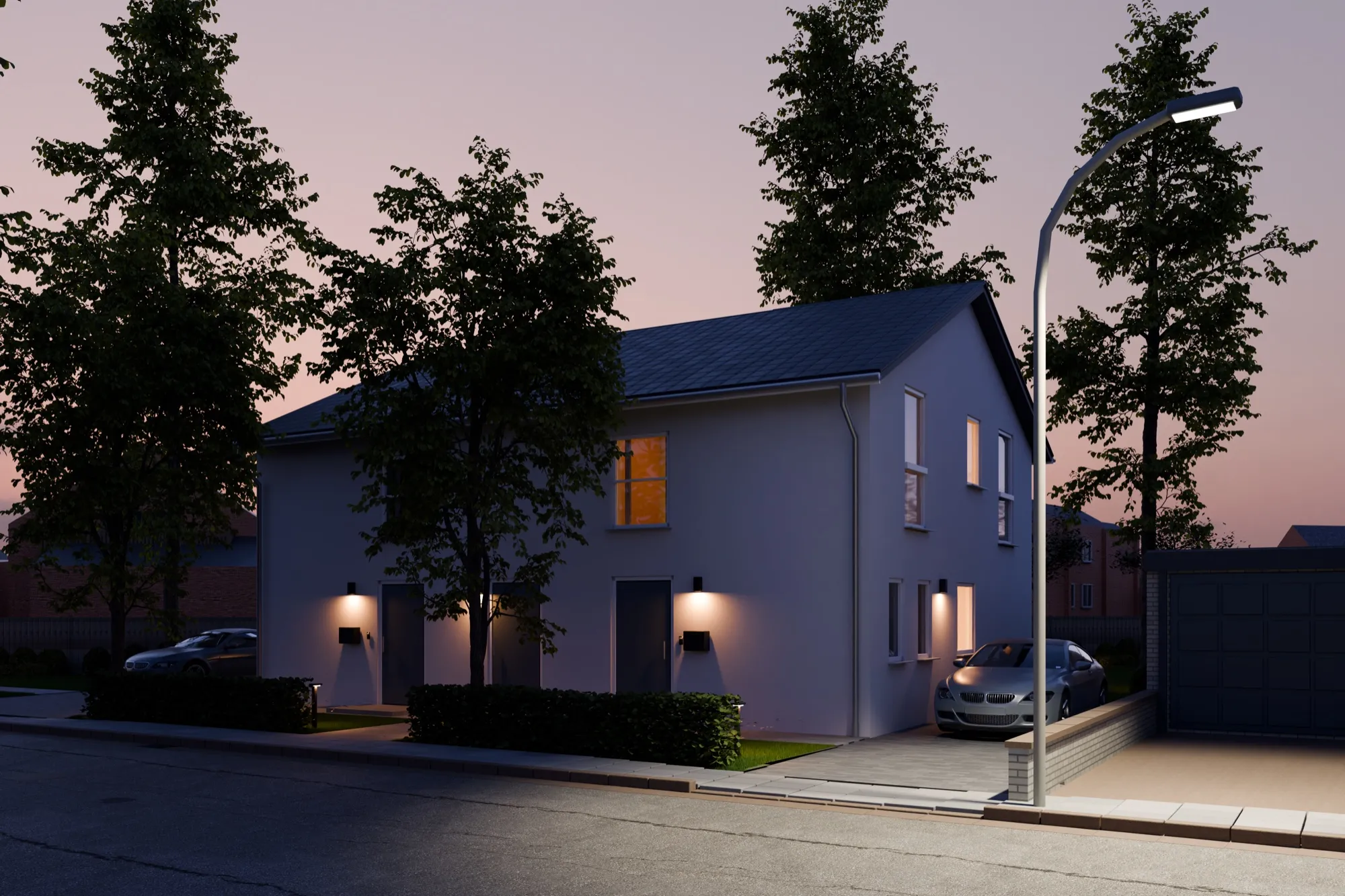
In Part 1 a coding agent constructed a Blender scene from floor plans, site photos and open geodata. My question was answered: I could see how the house sits among the trees. Then I showed the result on LinkedIn.
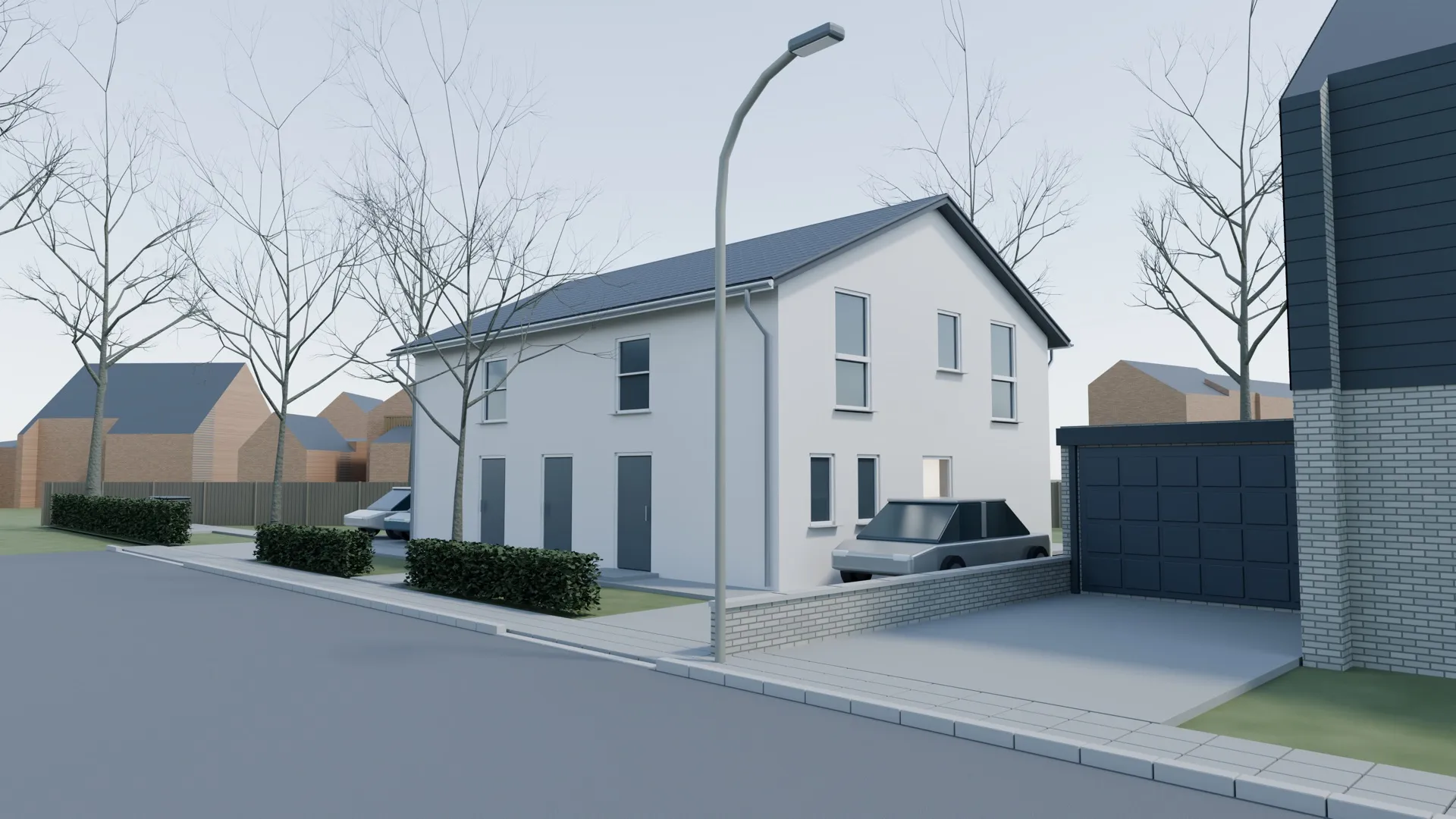
The comments from the visualization, architecture and construction industries tore it apart; the details are at the end of Part 1. Nobody could hand me a better challenge.
AI changes many things. This project shows two of them especially clearly:
- The barrier to entry drops. Without AI I would never have started something like this.
- The time to a first result shrinks. The first presentable state came together in half an afternoon.
What used to take painstaking learning, and I know what that is like, is far easier with AI today. People in all kinds of industries will have to accept that their work is changing too. Someone on LinkedIn put it to me in a sentence I know just as well from engineering: you will not be replaced by AI. You will be replaced by someone who uses AI and uses it well.
The criticism of the visual quality was fair. The image above shows bare trees made of thin tubes, a street as a gray surface and a car made of boxes.
I wanted to know how far a layperson in 3D visualization gets with the same tools by taking that criticism seriously. This part is less about Blender than about how you steer an agent when you do not know the craft yourself.
The subject is not entirely foreign to me. I used to photograph a lot and worked as a photographer for a while, including industrial photography. Light, shadow, perspective, aperture and focal length are familiar to me.
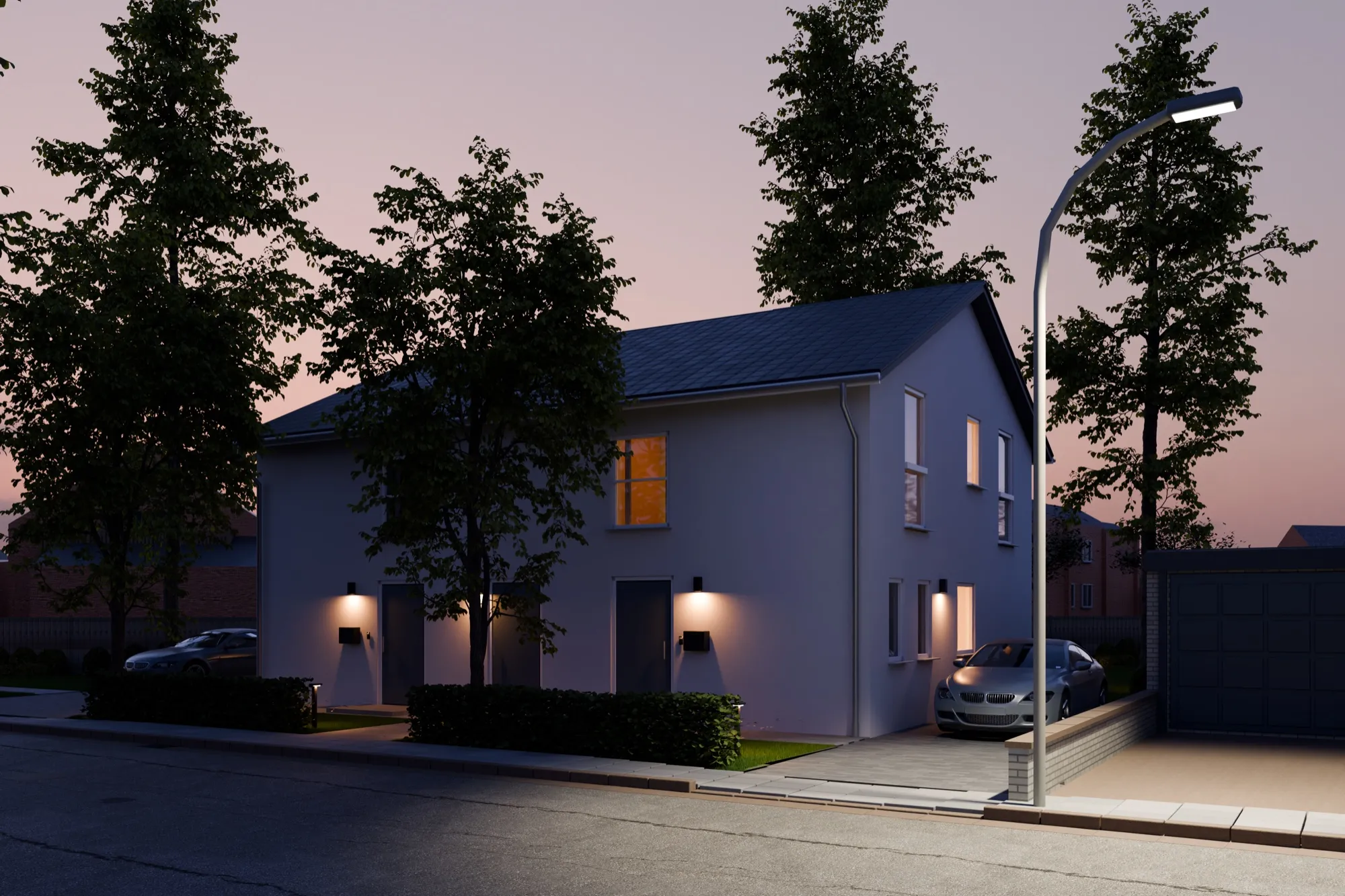
Codex built the model and carried out most of the rework. Claude first appears as a research tool and second reviewer. At the end, Claude Code takes over the execution. Why is covered in Part 3.
Research as the yardstick
I could see for myself that the images were bad, and from a photographer’s point of view I could name some of the causes. But “make it prettier” is not an instruction.
One thing I know from engineering is that most knowledge has long been written down, as best practices, guidelines and methods. Architectural visualization would be no different. So, deep research. I ran the same research question through Claude and ChatGPT: methods, quality criteria and typical mistakes of high-end architectural visualization in Blender, for a single person without a studio.
The two reports differed, and that was exactly what made them useful. The first report covered technical methods: lighting, camera, materials, rendering, post-production, plus a list of mistakes and a scoring rubric with 100 points.
| Category | Points | What it looks at |
|---|---|---|
| Lighting | 25 | plausible light, warm and cool contrast, soft shadows |
| Composition and camera | 20 | straight verticals, focal length and camera height, foreground for depth |
| Materials and shading | 20 | beveled edges, signs of wear, no repeating patterns |
| Realism and technical cleanliness | 15 | no image noise, correct scale, clean geometry |
| Storytelling and mood | 15 | surroundings, people without kitsch, weather and season |
| Assets and vegetation | 5 | high-quality plants and furniture, no artificial-looking grass |
The report classifies scores above 90 as editorial quality, above 75 as professional work and below 60 as the typical real estate render.
The second report focused on the visual approach. Its central recommendation:
Do not treat your Blender model like a property that has to be documented. Treat it like a real house that a very good architectural photographer would shoot for a magazine.
It came with statements that gave me a vocabulary for architectural visualization. Many developer renderings, it said, are product catalogs in which everything is visible at once and everything is equally bright. Every image needs a clear visual idea and a deliberate approach to lighting, shadows are allowed to be deep, and three to five exceptional images beat fifteen mediocre ones.
Both documents went into the project folder as files. The assignment to the agent was: read them completely, derive a plan, score every render against the rubric and iterate. Below 85 points, work continues. What stayed binding was the geometry of the house and its position on the plot. Light, season, camera, materials and furnishing were free.
In the comments, an architect had shown a design of his own in evening light. That image became the reference, broken down into eight features to adopt, from warm light in the windows to a camera with straight verticals.
None of this is secret knowledge. You only have to look, and walk through the world with your eyes open.
The agent scores its own work too generously
The first scores under the rubric were between 60 and 74. After a night of work the agent reported 83 to 84 points for three of the four target images. The goal of 85 was almost reached. A student grading his own exam would probably also land just below top marks.
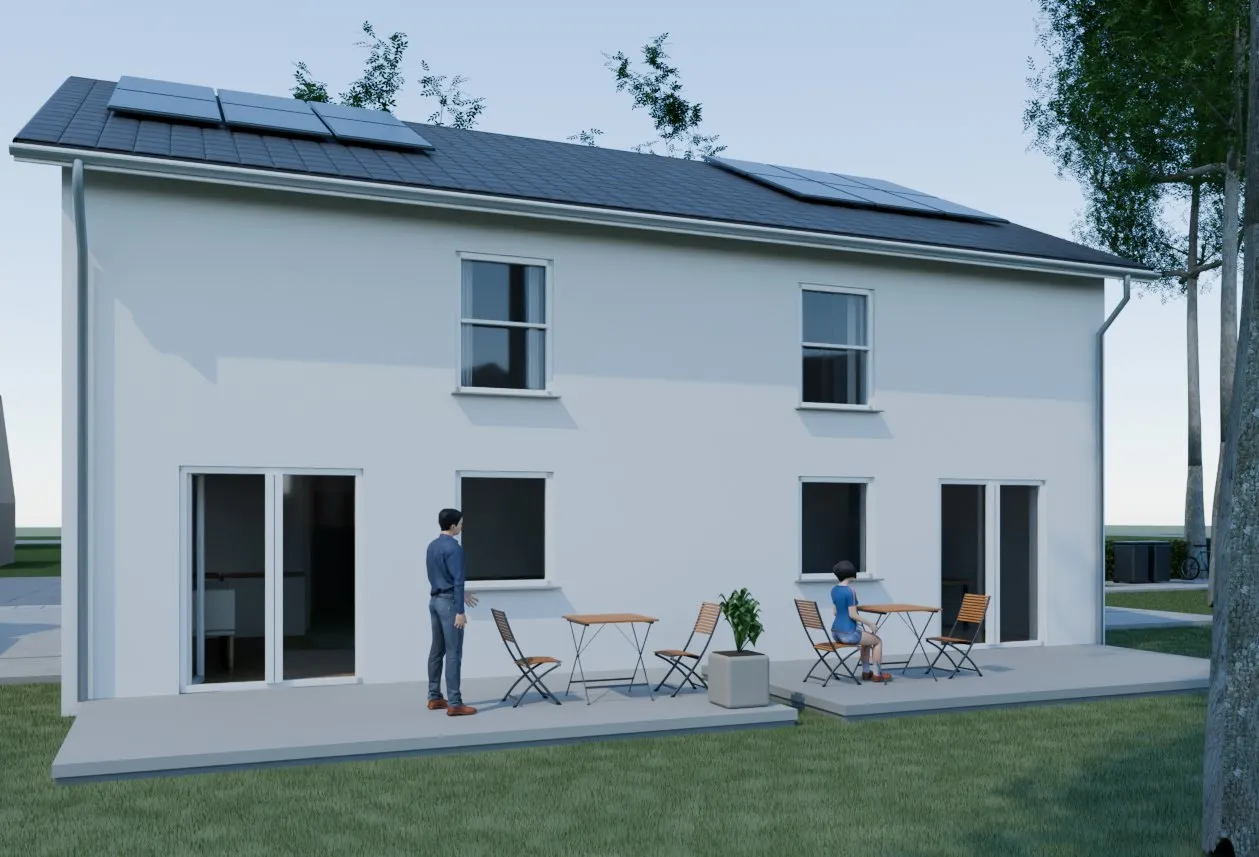
My verdict was different. The images looked just as crap as before: digital through and through. When I said so, the agent conceded that it had scored too generously. An hour later the same family of images came in at 75 after a stricter review.
That is the most important limitation of this approach, and it is familiar from programming. An agent that reviews its own code is biased toward a positive verdict. Images are no different. It always pays to have a different model judge as a counterweight, and I did that repeatedly along the way.
The rubric was still valuable, for a different reason. It gave us a shared language. You could also call these criteria guardrails, if very soft ones. When the lawn looked artificial to me, the agent could look for obvious repeating patterns and check the height and placement of the grass. When it proposed a camera, it justified it with focal length, eye level and foreground.
Six patterns I used to steer
In eight days I sent more than 300 messages. I sent them from everywhere: while shopping, walking the dog, doing laundry, and on the couch in the evening. Most follow a handful of recurring patterns.
1. Image critique: what I see, what I expect
My most frequent message was a screenshot with a list. Each point describes what I see and what I would expect. An example from a list of seventeen points:
It is a residential area: nowhere can you see the horizon. Everywhere there are trees, houses or the like.
I know little about shaders. I do know how parking spaces are paved here, how the windows sit back from the wall above their sills, and how the surrounding houses and trees block the horizon. For the horizon, the agent found the cause: the import of the building data was limited to 85 meters, and exactly the houses behind the gaps in the gardens were missing. After that, the horizon was built up.
2. Stopping when things go in circles
On the second day of the rework, several garden variants were produced one after another in which the only open issue was one figure and the position of her arms. I had the feeling we were going in circles, so I made the agent stop and asked for an overview of where we stood.
The overview showed three big things holding back quality across all images: the rear trees, the lawn and the schematic neighborhood. That turned into a written task plan with a cap per category.
The agent was working under a standing goal that kept it running after every stop. It did not stop reworking on its own, so I had to order it to take a step back.
This pattern is common with agents, especially with Codex. In code review it finds something new to change in every round. In professional work I have sat through eight or twelve review rounds in a row. No engineer would ever put up with that. They would run away screaming and hand in their notice. The agent just keeps going. This is where you need the human in the loop.
For all the criticism of the human in the loop, this project simply did not work without one yet. Much of this can surely be done better, but in this first experiment the human was clearly necessary.
It is important to write down the rules for this in advance, in two stages. After two unsuccessful attempts at the same defect, the agent changes its method instead of piling on patches. If three to five rounds bring no progress overall, the work stops and a human decides how to continue. I do that routinely in professional work. It would have helped here from the start.
3. Pointing back to the research
With the trees, the agent had spent four rounds matching leaf counts. Both walnut trees in front of the house ended up with exactly 2,673 leaf copies and still looked like wire frames with foliage at the tips. Impeccable bookkeeping, questionable botany. I had no solution, so I pointed it back to the research: what did it say about trees and foliage?
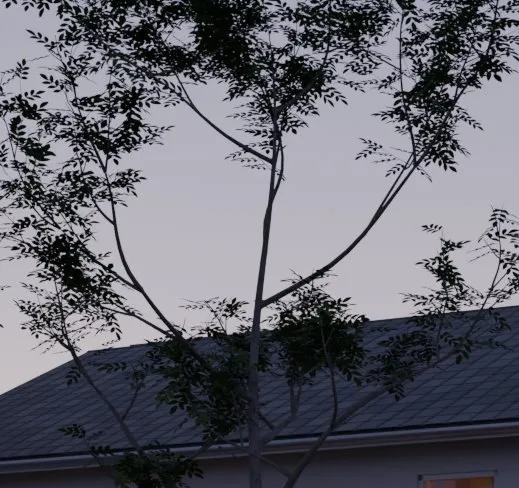
They say that the silhouette comes first. A prominent object has to convince through its shape alone, even without surface textures. After that the agent judged trees by their crown structure. When no freely available tree model was convincing, it programmed a branching structure itself. That was the first visible jump.
4. A second opinion with a limited brief
Codex was initially allowed to ask another model, Claude, for a verdict once. I set the conditions explicitly: three images, no rubric, no scoring scale, no target value, no previous findings, no expectation. The result is stored verbatim, separate from our own assessment, and nothing is adopted unchecked.
The separation was necessary. Several of the reviewer’s findings were wrong. It claimed that two front doors had no access, but the hedge obscured that part of the scene from its viewpoint.
I tied a second run to a condition: only if progress stalls, with a documented trigger, and this time with the assignment to make radical proposals. The strongest proposal was to rethink the camera setup and lighting instead of adding more details. That was the second visible jump.
5. Measuring when looking is no longer enough
The most stubborn problem of the project was an edge. Where the lawn meets the patio slabs, the images showed dark holes. Codex tried to fix it four times. Four times the image looked the same as before.
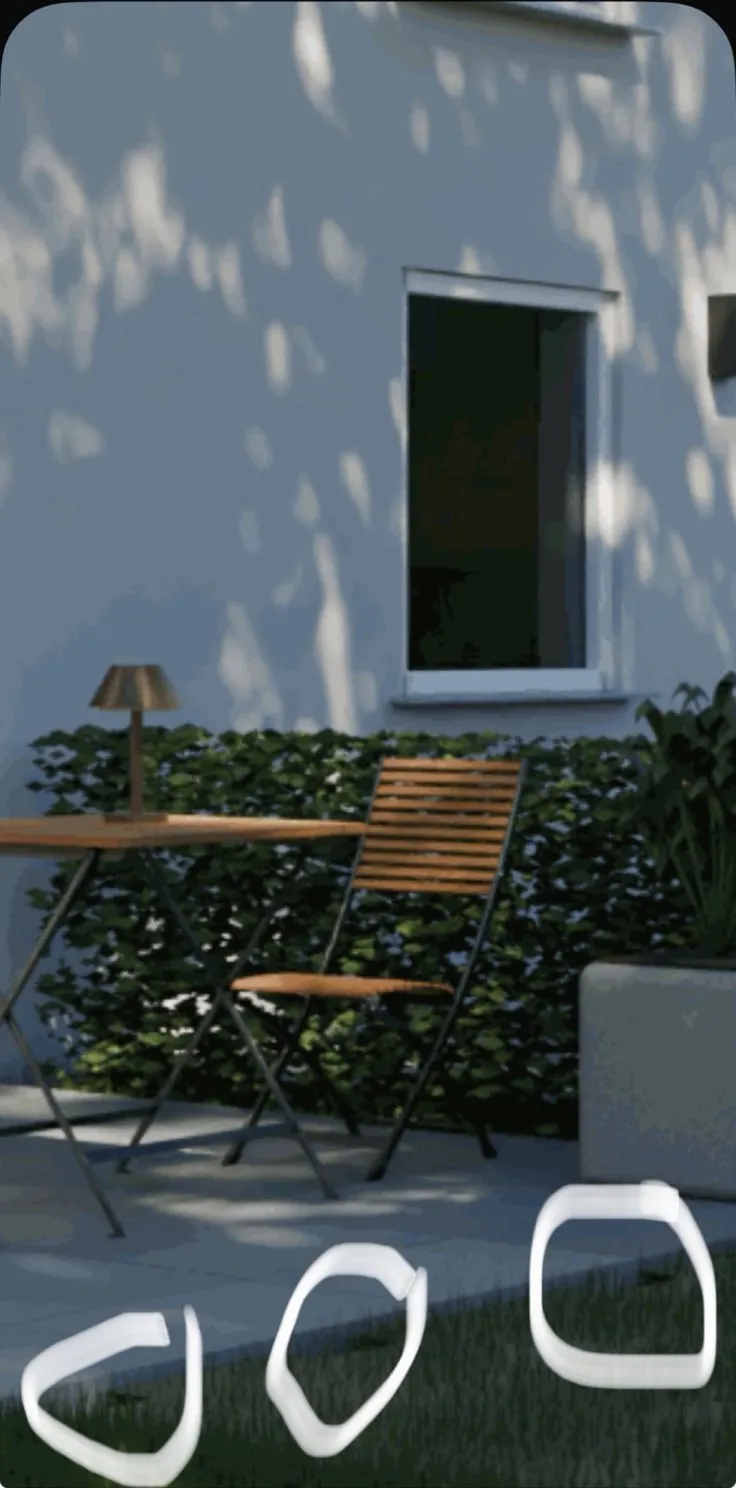
After the third attempt I stopped just looking. I had a Claude session measure the rendered images and read Codex’s scripts.
The measurement showed that the fix had changed a strip next to the holes. Looking into the scripts revealed a design flaw that no image would have given away. And the “weird little trees” I had complained about were three quarters of a million artificial grass blades along the edge. Three quarters of a million blades to close one edge, and the holes were still there.
Two steps solved it. The agent discarded the entire chain of fixes and rebuilt the lawn from a clean state. And a short piece of research explained why the joint had never looked believable: in reality a lawn almost never meets concrete directly, there is a strip of edging in between. The objective itself had been wrong.
6. Knowledge about the place
Claude had given the street pronounced wheel ruts. They were wrong. The street in front of the house is a small turning circle from the 1990s with hardly any traffic. No trucks drive there. After that one piece of information the agent discarded the ruts and rebuilt the street.
The agent had lacked that information about the street. I could supply it from my own observation.
Acceptance, image by image
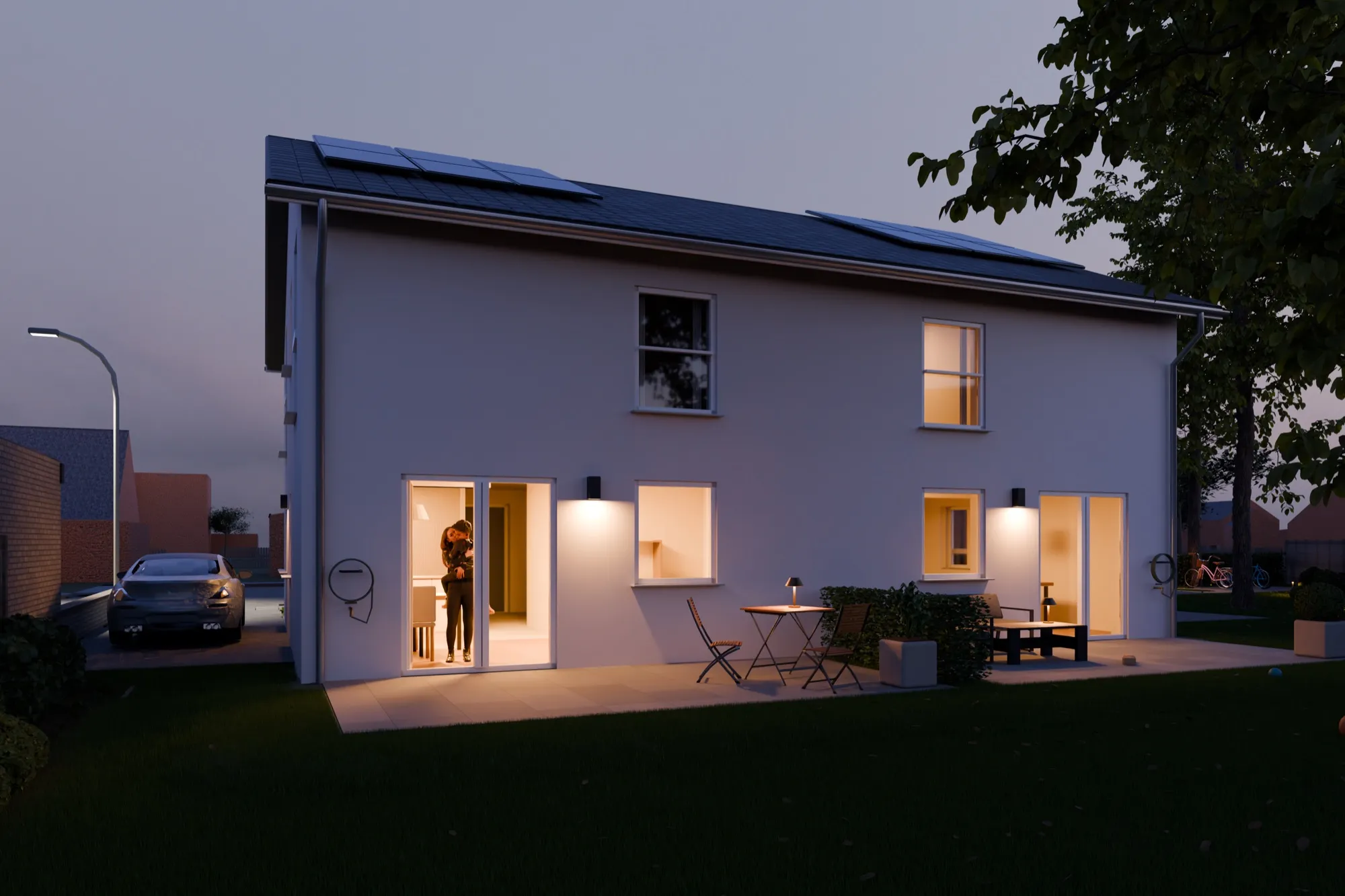
For the lighting moods, Claude presented 48 variants as a contact sheet, an overview of small preview images. I find it much easier to judge images individually. Since then the AGENTS.md says that images are shown one at a time, and acceptance went image by image.
The planned post-processing shrank to minimal interventions; the raw render was usually the better image already.
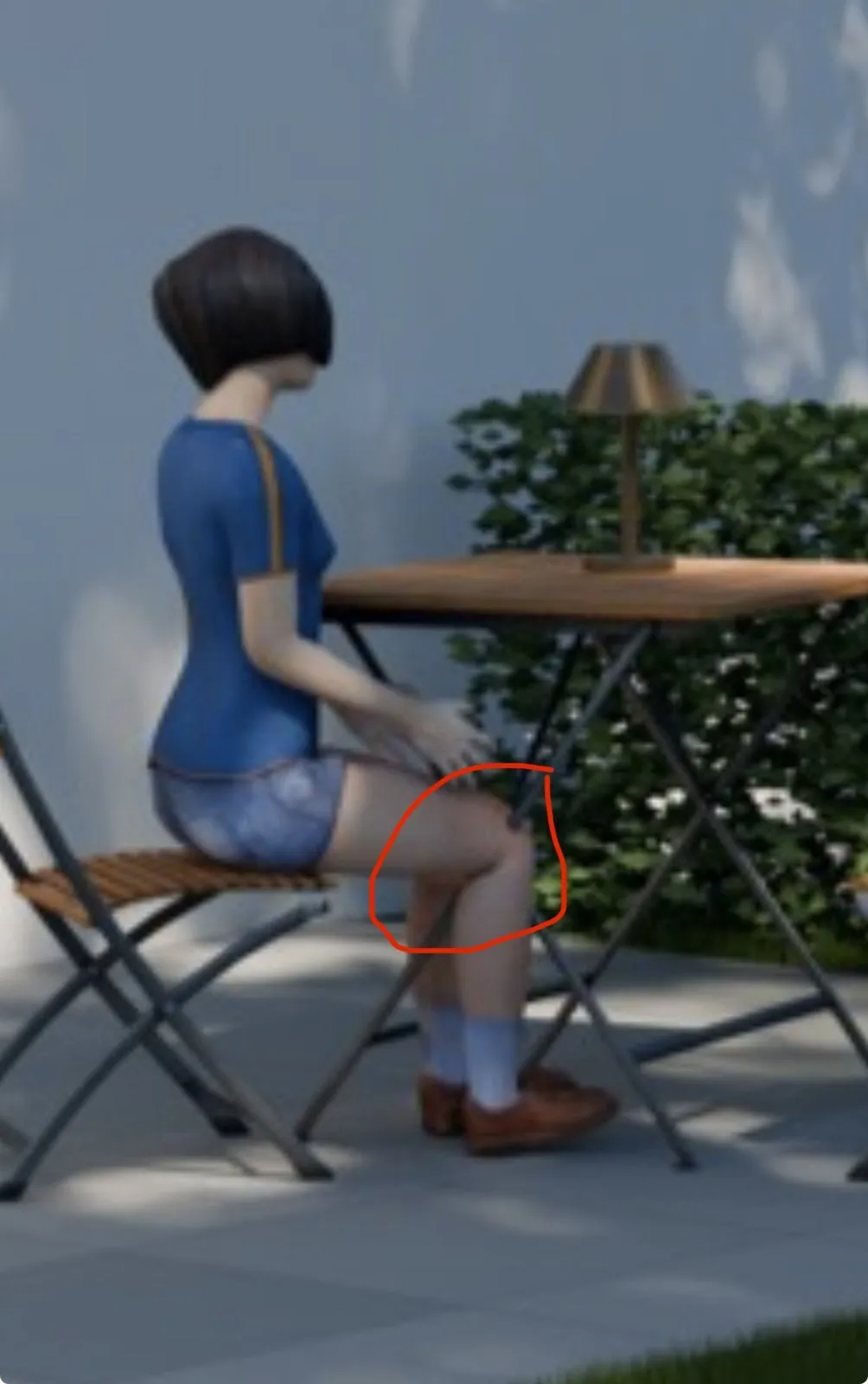
While the final render was running, I noticed in a preview a knee stuck in the strut of a garden table. The seated figure was removed from all images, including the ones I had already accepted.
I accepted seven exterior images individually, and later two interior views.
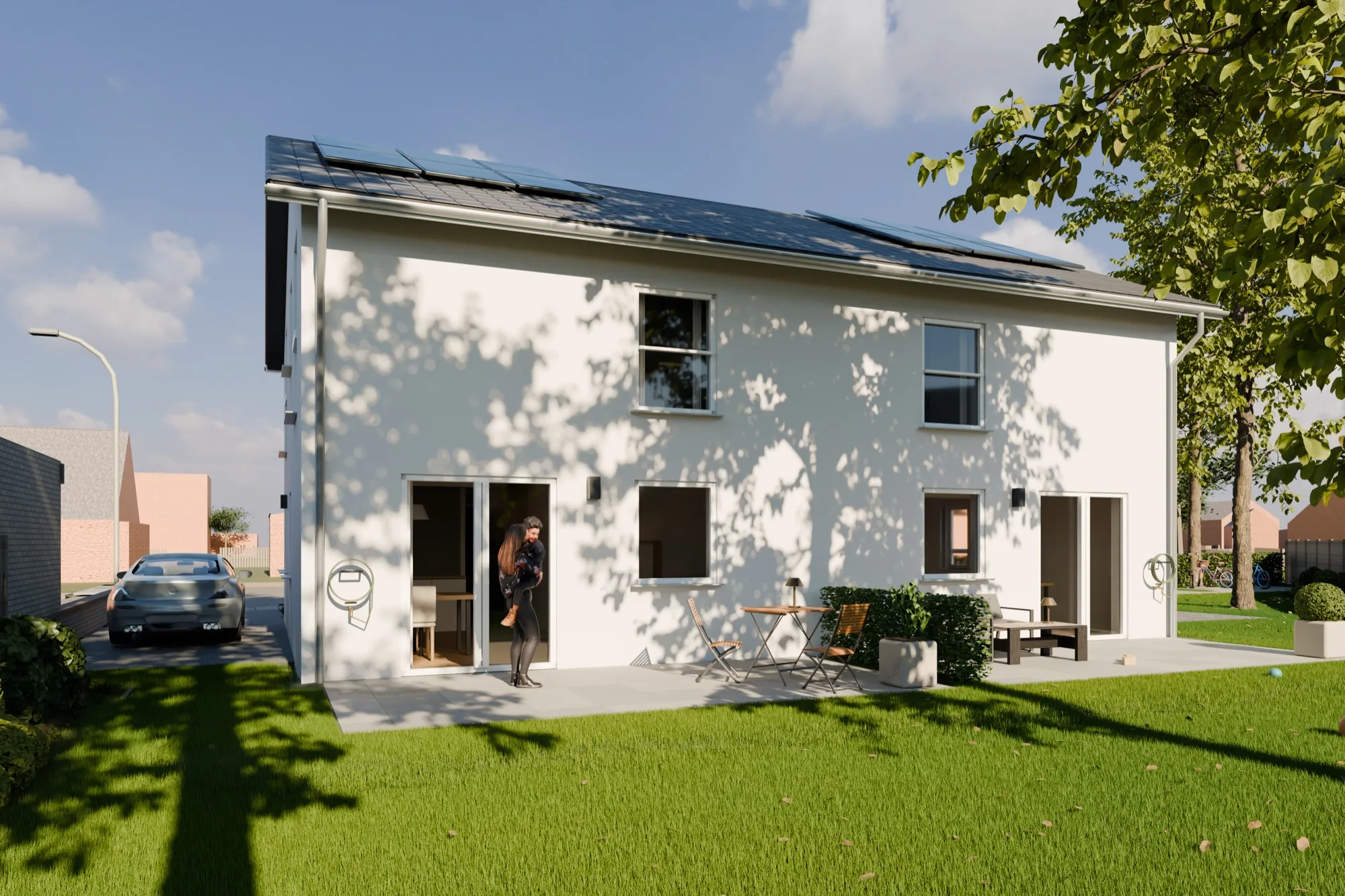
What stays from this part
I did not learn the craft that week. The images improved because I could describe what I saw, because research gave me a yardstick for it, and because I stopped the work when it went in circles. Measuring came in where looking was no longer enough.
Part 3 shows what happens when you work this way from the start. With a clearly defined goal and what we had learned in those days, a very good interior render came together without many further revisions.

Facing a complex problem? Before any code, a conversation. No pitch, no commitment.
Book a call